.png)
Estimated Read Time: 7–9 Minutes
This is not the home maintenance article most homeowners want to read.
It is not about a dream kitchen.
It is not about a new bathroom.
It is not about the fun part of owning a home.
It is about the part even responsible homeowners put off.
Not because they are careless.
Not because they do not care.
Not because they are doing everything wrong.
Because life is expensive.
Kids grow. Cars break. Insurance goes up. Groceries cost more. A family trip matters. Sometimes the money simply has to go somewhere else.
So the paint that is “still fine” waits.
The gutters that can wait, wait.
The soft siding gets watched instead of repaired.
The dirty exterior becomes normal.
The HVAC filter gets changed later than planned.
The dryer vent gets forgotten.
The window sticks.
The fence leans a little more after every storm.
None of it feels like an emergency.
That is why it gets missed.
And then one day, usually at the worst possible time, the house needs an answer.
I have stood with homeowners who suddenly had to sell and realized the house was not ready. They were not bad homeowners. They were not irresponsible people. They were regular people who had been carrying regular life, and the maintenance list kept getting pushed to “later.”
Then later showed up with a bill.
Paint failure became siding repair. Missing or clogged gutters became fascia and soffit damage. A dirty exterior became a bad first impression. Small window issues became buyer concerns. A leaning fence became one more thing on the inspection list.
What could have been handled calmly over several years became one large, stressful repair package at the exact moment the homeowner needed time, equity, and control.
That is the hard truth about home maintenance: the house keeps score.
Not because it is trying to punish you.
But because sun, rain, humidity, pests, and time do not stop working just because life got busy.
The goal of this article is not to shame you. It is to help you think clearly, plan realistically, and protect yourself before the house forces the conversation.
Why Home Maintenance Budgeting Matters in Central Florida
Central Florida is tough on homes.
Our houses sit through intense sun, heavy rain, sticky humidity, insects, storm debris, and long cooling seasons. Paint breaks down. Caulk separates. Gutters clog. Wood trim softens. Siding takes on moisture. HVAC systems run hard for much of the year.
A homeowner may think they are saving money by waiting. Sometimes, for a short season, waiting is unavoidable. But over time, many delayed repairs are not savings. They are unpaid bills waiting for a worse moment.
A practical rule of thumb is to budget 1% to 4% of your home’s value per year for maintenance, repairs, and replacement planning. Fannie Mae and State Farm both cite this 1%–4% range as a common annual maintenance budgeting guide, and State Farm also notes that a square-footage rule may be useful when home values are inflated.
For many Central Florida homeowners, that often means:
1%–2% for newer or very well-maintained homes
2%–3% for average homes with normal aging
3%–4%+ for older homes, deferred maintenance, storm exposure, aging exterior systems, drainage concerns, or roof and HVAC issues
Maintenance is not about having a perfect house. Almost nobody does.
It is about keeping your home from getting away from you.
Key Benefits
- Protects equity by keeping the home from sliding into visible neglect
- Reduces surprise repairs by catching issues before they spread
- Preserves buyer confidence when it is time to sell
- Keeps small problems from becoming multi-trade repair projects
- Helps prevent moisture damage, especially in Central Florida’s humid and rainy climate
- Extends the life of systems like paint, gutters, siding, windows, fencing, and HVAC
- Gives homeowners options instead of forcing rushed decisions under pressure
Potential Drawbacks to Consider
- Maintenance is not exciting because the best work often prevents problems no one sees
- It competes with real life, including family costs, insurance, vehicles, travel, school expenses, and emergencies
- Costs do not arrive evenly, so one year may be light and the next may require paint, gutters, siding, or system repairs
- Preventive work may not feel rewarding right away, even though it protects long-term value
- Waiting can make the final repair package larger
- Last-minute repairs before selling may not earn full buyer confidence
- Some corrective repairs add no “wow” value because they simply fix damage buyers expected not to exist
What Drives the Cost of Home Maintenance and Improvement
The expensive part of home maintenance is rarely the first thing you see.
It is what that issue has been doing behind the surface.
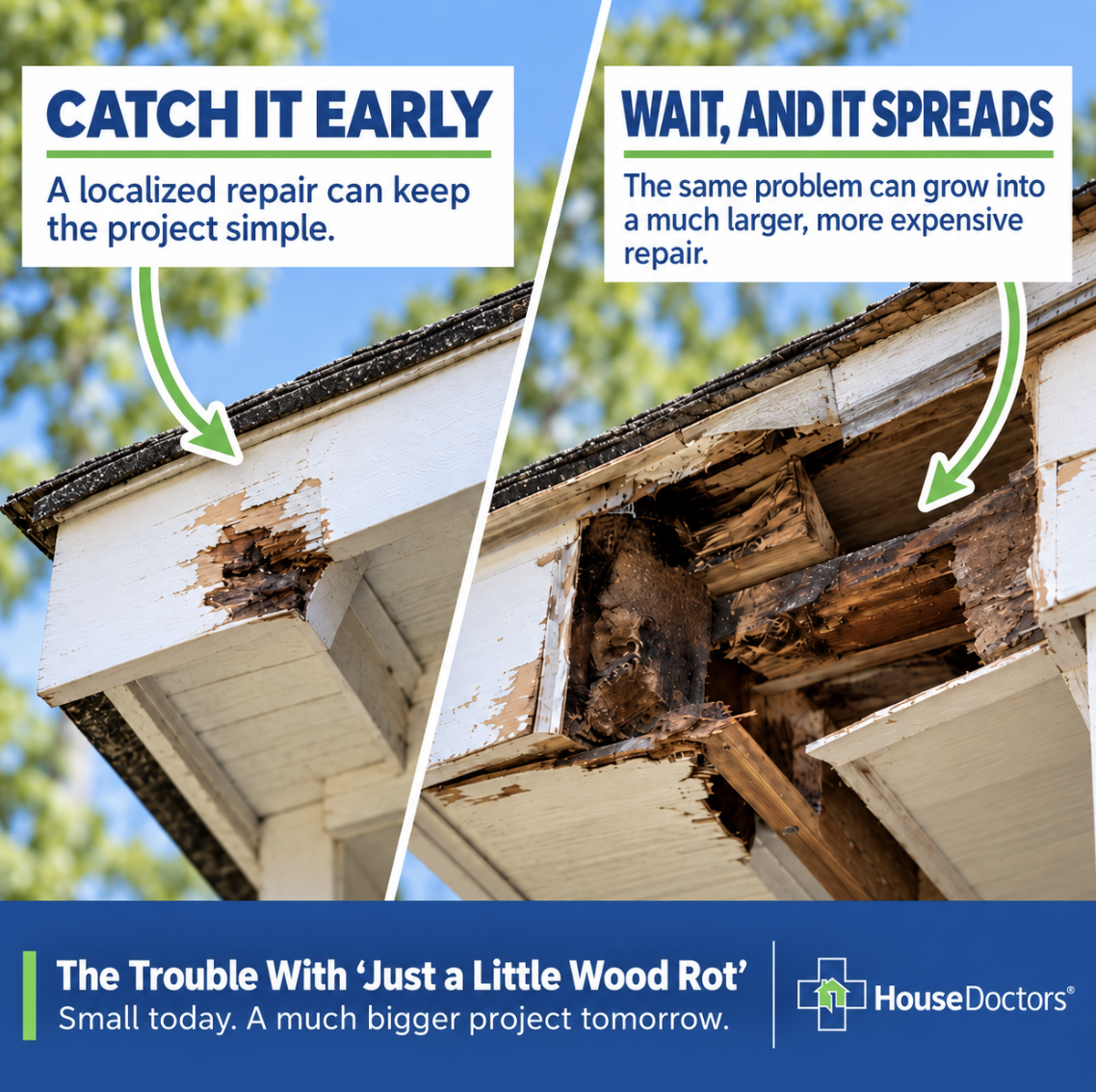
Peeling paint may not just mean the home needs paint. It may mean failed caulk, exposed trim, soft siding, wood rot, stucco cracks, or moisture intrusion. A planned repaint may cost thousands, but waiting until the exterior fails can turn paint into repair, repair into replacement, and replacement into a larger restoration project. At the time of publishing, Fixr reports that exterior painting in Florida commonly ranges from $4,000 to $10,000, with an average around $5,750 for a 1,500-square-foot home with moderate prep. Homeowners planning exterior work can read more in our guide to painting services in Central Florida.
Gutters are another example. Many homeowners treat them like an optional upgrade. In Central Florida, they are part of how the home manages heavy rain. Missing, clogged, or damaged gutters can contribute to splashback, fascia damage, soffit staining, soil erosion, landscape washout, and water collecting where it should not. HomeAdvisor reports 2025 gutter replacement costs ranging from about $3 to $40 per linear foot, depending on material, with seamless and higher-end materials costing more. Learn more in our guide to gutter repair, fascia, and soffit maintenance.
Siding and trim repairs work the same way. A small soft spot can become a larger exterior repair if water has been getting in for a while. Once siding, trim, sheathing, or framing is damaged, the homeowner is no longer improving the home. They are paying to get back to where the home should have been. Our guide to siding repair and replacement in Central Florida explains why these repairs often involve more than the visible surface.
That is the part homeowners need to understand.
Corrective repairs often cost real money but create very little excitement for buyers. A buyer is not impressed that rotted wood was replaced. They expected the wood not to be rotten.
Typical Cost Breakdown
At the time of publishing, homeowners should treat cost ranges as planning tools, not promises. The real price depends on home size, access, height, materials, hidden damage, labor, and how long the problem has been waiting.
Still, the comparison matters.
| Preventive Item | Typical Planning Range | What It Helps Avoid |
|---|---|---|
| Exterior painting | Several thousand dollars and up | Paint failure, exposed trim, siding damage, moisture intrusion |
| Gutters and downspouts | Low-to-mid thousands on many homes | Splashback, erosion, fascia damage, drainage problems |
| Pressure washing | A few hundred dollars | Algae buildup, staining, neglected appearance |
| Window cleaning | A few hundred dollars | Poor presentation, dull light, buyer doubt |
| HVAC filter changes | Low recurring cost | Restricted airflow, system strain, dust buildup |
| Dryer vent cleaning | Modest recurring cost | Fire risk, poor dryer performance, excess lint buildup |
| Siding or trim repair after neglect | Several thousand and up | Rot, water damage, exterior envelope failure |
| Drainage or foundation-related correction | Several thousand to tens of thousands | Serious structural concern and buyer hesitation |
Pressure washing and window cleaning may not feel important next to a roof, HVAC system, or major repair. But they affect how the home feels. HomeAdvisor reports average pressure washing around $310, with a common range of $212 to $448.
A dirty exterior, stained driveway, cloudy windows, algae buildup, and neglected fencing all send the same message:
This home may not have been cared for.
That message matters.
A buyer may not consciously pay more because the windows are clean, the fence is straight, the exterior is washed, and the paint is maintained. But they will absolutely notice when those things are missing. For more on related curb appeal and function, see our guides to fence repair and installation and window repair and replacement.
The point is not that every small maintenance item prevents a disaster. That would be fearmongering.
The point is simpler:
Small maintenance gives you a chance to stay ahead of the house.
Common Home Maintenance Budget Options & Choosing the Right System
There are three practical ways to budget.
The first is the percentage method. Set aside 1%–4% of your home’s value each year.
The second is the seasonal method. In Central Florida, that means checking gutters, drainage, exterior cracks, fascia, soffit, caulk, screens, fences, siding, and window areas before and after the heaviest rain and storm periods.
The third is the system-age method. Look at the age and condition of your exterior paint, HVAC, roof, water heater, gutters, siding, windows, doors, fencing, and drainage. Older systems deserve more planning because they rarely fail at a convenient time.
The best plan usually combines all three.
Maintenance should also be separated from improvements.
Improvements make a home better. Maintenance keeps a home from getting worse.
Both matter, but maintenance usually needs to come first.
A new kitchen is nice. A bathroom update can improve comfort. A backyard upgrade may make the home more enjoyable.
But if water is getting behind failing exterior paint, if gutters are dumping rainwater against the home, if siding is soft, or if the HVAC system is struggling through another Central Florida summer, the house is telling you what comes first.
Decision Guide: Spend Now, Wait, or Plan for Replacement?
- Ask whether this item protects another part of the home.
Paint, caulk, gutters, siding, windows, and drainage often protect deeper systems. - Ask what one more Central Florida season could do.
Heat, humidity, heavy rain, pests, and storms can turn small weaknesses into larger repairs. - Ask whether a buyer or inspector would notice it.
Peeling paint, rotten trim, clogged gutters, stained soffits, leaning fences, dirty exterior surfaces, and sticking windows create doubt. - Ask whether waiting saves money or simply delays the bill.
Some repairs can wait. Others quietly get more expensive. - Ask whether this is a planned cost or a forced cost.
Planned repairs give you time. Forced repairs take time away. - Ask whether the repair creates value or only restores lost condition.
Preventive maintenance protects value. Deferred repair often just brings the home back to acceptable. - Ask what happens if you need to sell sooner than expected.
Life changes. Jobs change. Families change. Health changes. Markets change. A home that has been maintained gives you more options when life moves faster than planned.
Long-Term Ownership & Maintenance
One of the most expensive homeowner thoughts is:
“I’ll just fix it when I sell.”
That sounds reasonable until the repair list is too large to fix affordably.
By then, the homeowner is not choosing between upgrades. They are choosing what to disclose, what to rush, what to credit, what to leave alone, and how much equity they are willing to give up.
A buyer does not care that you meant to fix the gutters later.
An inspector does not care that the paint was on the list.
The market does not give full credit for repairs that should have been done years ago.
And the math can turn painful fast.
Mortgage payoff. Realtor commissions. Closing costs. Moving costs. Repair credits. Last-minute contractor bills. Price reductions after inspection. Suddenly, the equity that looked strong on paper gets eaten up by problems that may have been manageable if they were handled earlier.
This is why home maintenance should not be compared only to putting money in savings or the stock market. Those things matter. But they do different jobs.
Savings gives you liquidity.
Investing may grow wealth over time.
Maintenance protects the asset you already own, live in, and may need to sell one day.
Even the small habits matter.
ENERGY STAR recommends checking HVAC filters monthly during heavy-use months and changing them at least every three months; a dirty filter slows airflow, makes the system work harder, wastes energy, and can lead to expensive maintenance or early system failure. The Department of Energy says filters may need cleaning or replacement every month or two during cooling season, especially with constant use, dusty conditions, or pets.
Dryer vents matter too. NFPA’s dryer safety guidance emphasizes that taking care of your clothes dryer helps prevent dryer fires, and dryer safety resources warn that lint and debris buildup can make the dryer work harder and create hazardous conditions.
These are not glamorous tasks.
But homeownership is built from repeated decisions. Over time, those decisions either protect the house or let it drift.
Maintenance buys options.
Deferred maintenance gives those options to the buyer, the inspector, the contractor, and the clock.
Conclusion
You do not have to maintain a perfect home. Almost nobody does.
But you do need to be honest about what the home is asking for.
Paint that is failing, gutters that are missing, siding that is soft, windows that are neglected, filters that are ignored, dryer vents that are clogged, and exterior surfaces that always look dirty are not just cosmetic issues. They are signals.
A maintenance budget will not prevent every surprise. Central Florida homes still age. Storms still happen. Repairs still come up.
But regular maintenance can prevent the worst kind of surprise: the one that shows up when you are trying to sell, move, refinance, recover equity, or make a major life change.
A well-maintained home gives you choices.
A neglected home creates pressure.
House Doctors of Orlando helps Central Florida homeowners look at those choices clearly, prioritize what matters, and handle repairs before small problems become expensive, emotional ones.