Estimated Read Time: 6–8 Minutes
There is a phrase contractors hear all the time:
“It’s just a little wood rot.”
Sometimes it is.
But wood often rots from the wet side first, and that is frequently the side you cannot see.
A soft corner of trim may be the whole problem. Or it may be the visible end of moisture that has already worked behind the trim, into a soffit, around a window, beneath siding, or farther into the framing.
And unfortunately, wishful thinking has never been a particularly effective wood preservative.
The reason to deal with rot early is not because every soft spot is an emergency.
It is because acting early gives you the best chance of keeping a small repair small.
Why Wood Rot Is So Easy to Put Off
Rot is easy to postpone because the house usually keeps working while the damage progresses.
The door still opens.
The roof still looks fine from the driveway.
The fascia has one questionable corner, but the rest seems solid.
So the repair lands on the familiar homeowner list of things to get to “sometime.”
The problem is that wood rot does not wait for a convenient weekend.
When wood remains damp long enough, decay fungi begin breaking down the fibers that give it strength. Removing the moisture can stop the conditions that allow further decay, but it does not rebuild material that has already deteriorated.
Dry rotten wood is still rotten wood.
And once decay has started spreading beyond the original area, waiting can change far more than the amount of wood that eventually needs replacing.
What You Can See Is Not Always What You Have
Homeowners naturally judge a repair by what is visible.
A six-inch soft section looks like a six-inch repair.
Unfortunately, moisture does not necessarily respect those boundaries.
Water can move along joints, exposed end grain, fasteners, backside surfaces, and concealed edges. Areas behind trim or siding can remain damp long after the exposed face has dried.
That means the visible spot may represent the full extent of the problem.
Or it may not.
This is one reason responsible wood rot estimates sometimes include an allowance for concealed conditions. We can inspect and probe what is accessible, but the exact boundary between sound and damaged material may not become clear until the affected area is opened.
That uncertainty generally becomes greater, not smaller, the longer the problem is allowed to continue.
Waiting Can Turn It Into a Different Repair
This is where wood rot becomes expensive.
The cost does not always rise gradually. Sometimes the repair crosses a line.
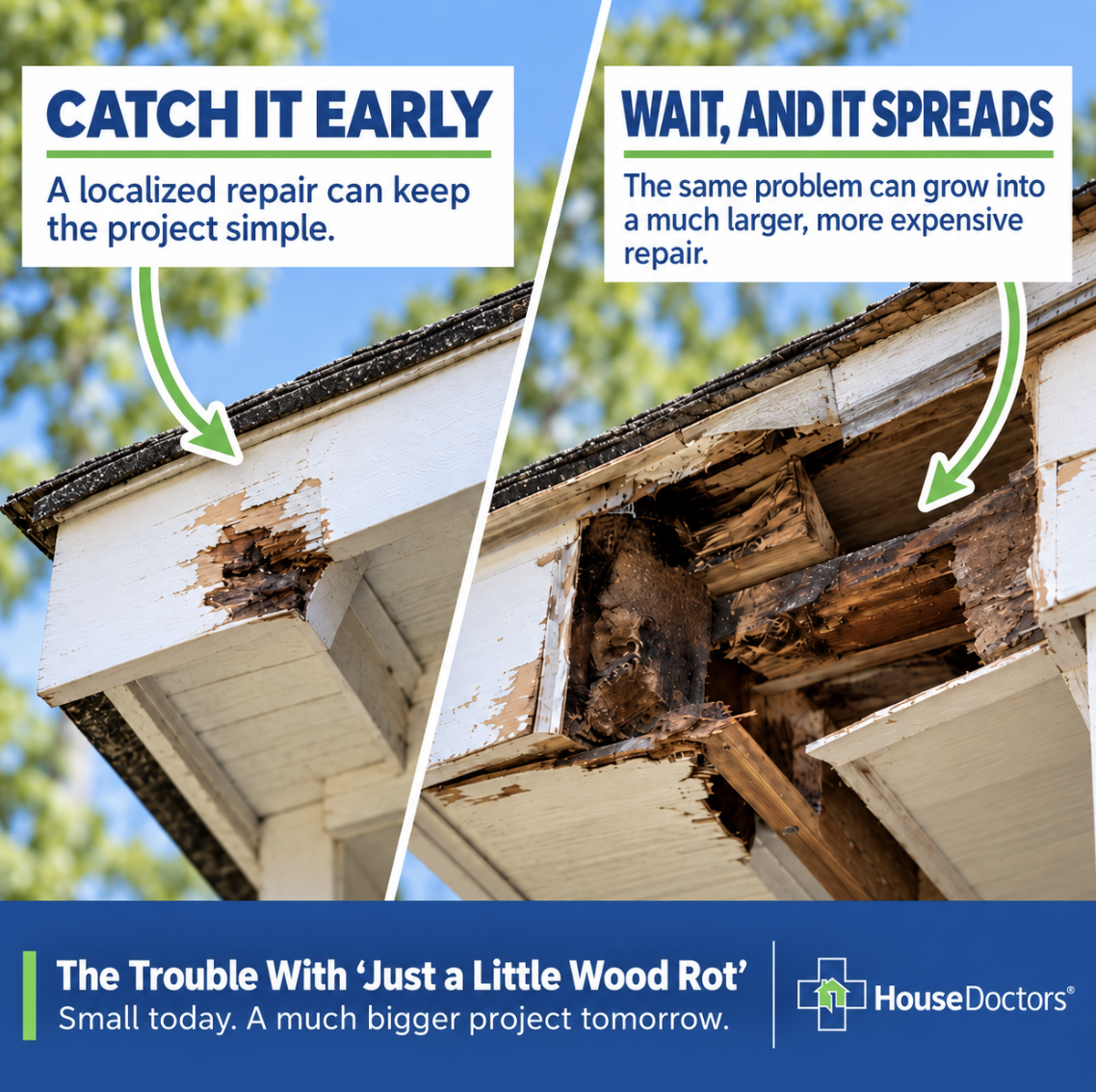
Consider a deteriorated rafter tail at the edge of a roof.
Caught early, the work may be limited to the damaged end, along with the fascia, soffit, finishing, and whatever correction is needed to keep the area dry.
Allow the decay to travel farther into the rafter and the situation changes.
Now the damaged material may extend beneath the roof itself.
Roofing or sheathing may have to be disturbed to gain access. More soffit and fascia may need to come down. Structural carpentry becomes more involved. More finished materials have to be removed and then rebuilt.
The problem did not merely become a little more rotten.
It became a different job.
The same progression can happen in other areas of a home:
- Rotten fascia can lead to soffit and roof-edge work.
- Rotten exterior trim can lead to siding removal and sheathing repair.
- Rot around a window can expose failed flashing or damaged wall material.
- Deteriorated porch trim can reveal damage in concealed framing.
- A small area of decay in stairs or decking can eventually involve the supporting structure underneath.
This is why the cost of waiting can rise much faster than homeowners expect.
You Are Not Just Paying for a Piece of Wood
The replacement lumber itself may be one of the least expensive parts of a wood rot repair.
Once damage reaches concealed areas, the job can involve:
- Careful demolition
- Access to hidden components
- Removal of otherwise serviceable surrounding material
- Carpentry or structural repair
- Correction of the moisture source
- Reassembly
- Caulking, priming, painting, and finish work
That distinction matters.
A homeowner may look at a small rotten board and understandably wonder why replacing it costs more than the board itself.
But the real work may be getting to it without causing unnecessary damage, determining where sound material begins, making the repair correctly, and then rebuilding everything that had to come apart.
The farther rot travels, the more of the house may have to participate in the repair.
That is where the bill grows.
Fix the Cause or Risk Paying for It Again
Rot needs moisture.
So replacing damaged wood without understanding why it remained wet can simply start the process over.
Sometimes the source is obvious: an overflowing gutter, roof runoff, or irrigation regularly spraying a wall.
Other causes are less visible. Failed caulk, poor flashing, exposed end grain, leaking joints, or details that trap water can keep wood damp far longer than expected.
In Florida, frequent rain and humidity can make those weak points less forgiving, particularly in shaded areas that dry slowly.
A lasting repair therefore has to answer two questions:
What has been damaged?
And:
Why did it stay wet?
Replacing the rotten wood addresses the first problem.
Correcting the moisture source helps keep you from paying for the same problem again.
Paint, Caulk, and Filler Have Limits
Paint and caulk are important parts of protecting exterior wood, and repair compounds can be useful in the right circumstances.
But none of them restores significant strength to badly decayed material.
Covering a soft area can improve the appearance without solving what is happening beneath it.
The goal should not simply be to make the rot disappear from view.
It should be to determine how far the damage extends, why it occurred, and what must be repaired to keep it from returning.
That is also why seemingly simple DIY patches can sometimes create false confidence. The area may look better while the underlying problem continues.
Should the Same Material Go Back?
Not necessarily.
When rotten non-structural trim or similar components need replacement, it may be worth considering PVC, composite, fiber-cement, or another moisture-resistant material where appropriate.
That does not mean traditional wood is automatically the wrong choice, nor are alternative materials suitable everywhere.
The bigger question is simply worth asking:
If this area failed once, is rebuilding it exactly the same way the best long-term solution?
Material selection is a subject of its own, but a rot repair can be a good opportunity to consider it.
The Least Expensive Version of the Repair IS the One You Have Today
No contractor can responsibly claim that every soft board is hiding a major problem.
Sometimes a small repair really is a small repair.
That is good news.
The problem with waiting is that you are gambling with the opportunity to keep it that way.
A damaged rafter tail may still be a rafter-tail repair today.
A deteriorated piece of fascia may still be confined to the fascia.
A soft section of trim may not yet have affected what sits behind it.
Once decay moves farther into the assembly, however, you are not simply replacing more rotten wood. You are often paying for more access, more demolition, more reconstruction, more finishing, and more uncertainty.
That is the real cost of waiting.
At House Doctors of Orlando, we would much rather evaluate a suspicious soft spot while the repair still has a chance of being straightforward than arrive later after several surrounding components have joined the project.
So if you have noticed soft wood, peeling paint that keeps returning, deteriorated fascia, damaged trim, or a questionable rafter tail, it is worth finding out what is happening.
Not because you should assume the worst.
Because “just a little wood rot” is the version of the problem you want to catch while it is still true.