

Why Siding Matters in Central Florida
In Florida, most homeowners understand the importance of keeping an eye on their skin. A small spot or change might not seem urgent—but it’s something you watch, because you know what constant sun exposure can do over time.
Your home’s siding works the same way.
In Central Florida, siding doesn’t get a break. Between intense sun, high humidity, heavy rain, and seasonal storms, it’s under constant stress year-round. What starts as a small crack, a loose panel, or fading paint often doesn’t stay that way.
That’s where problems start.
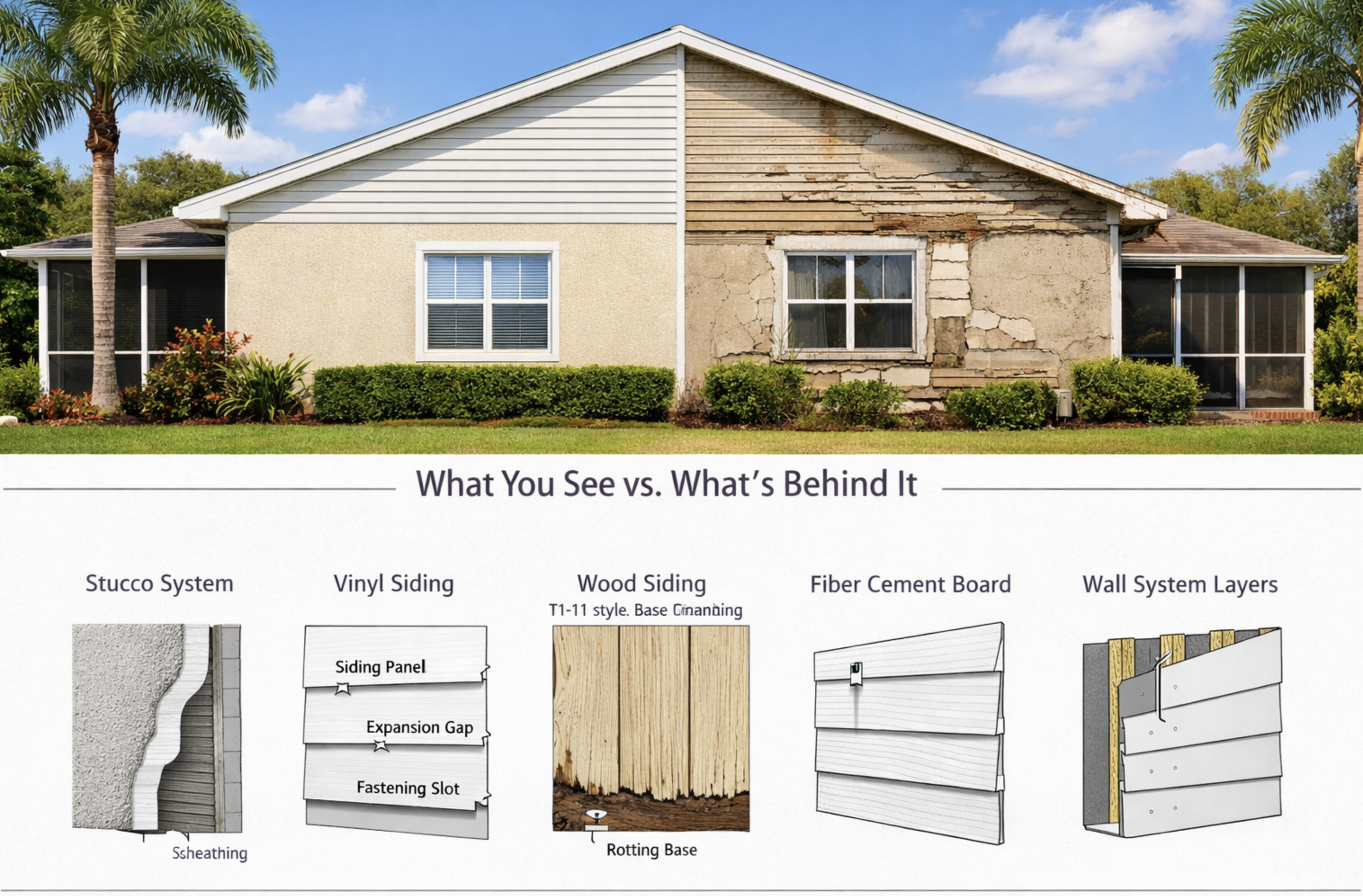
Because the real issue usually isn’t what you see on the surface—it’s what’s happening behind it. Moisture finds its way in, and materials begin to break down—often slowly at first.
Much like getting stuck behind a sandhill crane that refuses to move, what seems like a small delay can quietly turn into a much bigger disruption if it’s ignored long enough.
Key Benefits
When siding is performing as it should, it quietly protects your home every day.
- Protects your home from moisture intrusion and structural damage
- Shields against heat, humidity, and storm exposure
- Enhances curb appeal and long-term property value
- Helps prevent pest and insect intrusion
- Supports a complete water management system
Potential Drawbacks to Consider
Over time, even well-built siding systems can develop issues—especially in a climate like Central Florida.
- Hidden damage can lead to scope creep during repairs
- Improper installation can shorten the lifespan of otherwise durable materials
- Material-specific risks such as wood rot, cracking, warping, and corrosion
- Repairs may become more involved once underlying issues are uncovered
- Deferred maintenance—especially paint and sealing—can significantly increase costs
What Drives the Cost of Siding Repair
Understanding cost starts with understanding how siding actually fails.
In many cases, what appears to be a small issue on the outside is only a symptom. Once the siding is opened, underlying damage often becomes visible—and that’s where projects can expand.
- Hidden moisture damage – Rot, deteriorated sheathing, or corrosion behind the siding
- Extent of failure – One isolated area vs multiple affected sections
- Material type – Each system requires a different repair approach
- Accessibility – Multi-story homes or difficult areas increase labor complexity
- Installation details – Missing components, improper fastening, or poor transitions
- System connections – Rooflines, windows, fascia, and additions like pool enclosures
In real-world Central Florida homes, installation quality often determines how these issues develop. Even high-quality materials can fail when critical details are overlooked.
This is also where scope creep comes into play. Once the system is opened, addressing underlying damage is what ensures the repair actually lasts.
We also frequently see galvanic corrosion, particularly around pool screen enclosures. Aluminum structures are often attached using incompatible fasteners, and in a humid environment, that combination leads to rust, staining, and deterioration at connection points.
At the time of publishing, siding repairs in Central Florida typically fall into mid-to-high-end ranges due to the labor involved and the need to address both visible and hidden issues properly.
Typical Cost Breakdown
While every home is different, most projects fall into the following ranges:
- Minor repairs (isolated damage): $750 – $2,500
- Moderate repairs (multiple areas): $2,500 – $8,000
- Extensive repairs (with underlying damage): $8,000 – $20,000+
- Full replacement: $20,000 – $60,000+ depending on material and home size
At the time of publishing, these ranges reflect proper repair practices—not temporary fixes.
Common Siding Options & Choosing the Right System
With cost and failure in mind, it helps to understand how different siding materials behave in this climate.
While many siding types exist nationwide, most homes in Central Florida rely on materials designed to handle heat, humidity, and storm exposure.
Stucco (Traditional & EIFS)
- Widely used throughout the region
- Prone to cracking and moisture intrusion
- Advanced deterioration can lead to rusted metal lath and weakened backing, causing sections to lose support
Vinyl Siding
- Often considered maintenance-free—but it isn’t
- Can warp or buckle if installed too tightly, restricting natural expansion
- Over time, UV exposure leads to brittleness and reduced durability
- Improper painting can accelerate failure
T1-11 / Wood Siding
- Vulnerable to wood rot and insect damage (termites, carpenter ants)
- In some applications, serves as both siding and structural sheathing
- Failure can impact both appearance and structural integrity
Fiber Cement (Hardie Board)
- Durable and moisture-resistant
- More brittle than wood, making it susceptible to impact damage from debris during storms or routine yard work
Metal / Aluminum Siding
- Less common locally
- Can dent, corrode, or deform under high winds
- Unlike vinyl, it does not return to shape once bent
Across all of these systems, long-term performance depends less on the material alone—and more on how well the system was installed and maintained.
Your Siding Is Only the First Line of Defense
To fully understand siding performance, it helps to look beyond the surface.
Siding is not designed to make your home waterproof. Instead, it works as part of a water management system that directs moisture away from the structure.
Behind the siding are components such as water-resistant barriers (WRB), flashing, sealants, tapes, and fasteners. Together, they form a layered system that manages water as it moves through and around the exterior.
When this system is working properly, you don’t notice it. When it isn’t, problems develop quietly.
Caulking (sealants) protects the most vulnerable areas—joints, seams, and transitions. In this climate, these materials degrade over time, allowing water to bypass the siding.
Small details matter. We often see failures tied to improper fasteners or non-stainless staples that corrode, weakening the system over time.
And much like Disney’s “Go Away Green,” some issues blend in at first. By the time they become obvious, the repair is often more involved.
For a deeper look at how paint and sealing protect your home, refer to our guide:
https://www.housedoctors.com/orlando/blog/categories/handyman-services/a-homeowner-s-guide-to-painting-services-in-cent/
Hidden Issues We Commonly See
In practice, siding failures rarely come from a single cause.
More often, we see a combination of factors working together over time—moisture exposure, aging materials, failed sealants, and installation details.
By the time these issues become visible, multiple layers of the system may already be affected.
Decision Guide: Repair, Replace, or Maintain?
With all of this in mind, the next step is understanding how to approach a problem when it appears.
- Start with what you can see
Look for cracks, warping, soft spots, or staining. - Consider what may be happening behind it
Surface issues often point to deeper conditions. - Check for moisture-related signs
Swelling, separation, or discoloration are common indicators. - Evaluate the age and lifecycle of the material
Some siding types—especially vinyl—have a finite lifespan.
Like asphalt shingle roofs, they eventually require full replacement, not just repair. - Think long-term, not just immediate cost
Lower upfront materials often result in higher lifetime ownership costs. - Know when it’s not a DIY project
What looks simple on the surface often involves multiple layers of repair.
Incorrect fixes can trap moisture and make the problem worse.
Long-Term Ownership & Maintenance
Once repairs are complete, ongoing maintenance becomes the key to long-term performance.
- Maintain a strong paint and sealing system to shed water
- Inspect and replace caulking regularly
- Address small issues early to keep repairs manageable
- Monitor high-risk areas like rooflines, windows, and attachments
- Recognize when materials are nearing the end of their lifespan
- Schedule inspections, especially after storms
Siding doesn’t fail all at once—it gradually loses its ability to protect your home.
Conclusion
In Central Florida, siding is more than a finish—it’s part of a system designed to manage water and protect your home over time.
When that system is maintained, issues tend to stay manageable. When it’s not, problems can develop beneath the surface and become more involved to repair.
Understanding how siding works—and how it fails—helps you make informed decisions and avoid unnecessary surprises.
And when the issue goes beyond what’s visible, addressing the full system properly is what ensures a lasting solution.