How Austin homeowners can compare scope, allowances and the full project budget
Quick answer: Two remodeling bids can differ by $40,000 because they include different construction work, materials, allowances and responsibilities. One may keep the layout and use standard products; another may relocate plumbing, enlarge the shower and include custom cabinetry. A lower bid can be good value. A higher bid should explain what the additional money buys.
You show two contractors the same room and describe the same goal. One proposal comes back at $35,000; the other comes back at $75,000. That gap deserves an explanation before you sign either one.
The first step is to compare the finished result and the work required to achieve it. “Remodel the bathroom” leaves room for very different interpretations. Once the scopes match, you can judge differences in pricing, experience, coordination and service on their merits.
This guide is part of our Austin remodeling and home addition pricing series. The examples focus on bathrooms, but the same comparison applies to kitchens, larger interior renovations and general contracting projects.
Start by agreeing on the scope level
Bathroom scope | Austin planning band | Main boundary |
Simple refresh | $8,000–$20,000 | Selected finishes and fixtures; retain a sound wet area and existing layout. |
Complete hall or guest bath | $20,000–$40,000 | Rebuild the wet area and replace major finishes, usually in the same layout. |
Primary or custom remodel | $40,000–$90,000+ | Larger room, extensive finishes or custom construction; layout changes may be included. |
These are scope-based planning bands before contingency, not fixed packages or measured averages. Include labor, products, coordination and required design or permit costs in the total, even when paid separately. A larger primary bathroom can exceed $40,000 without moving walls. Custom work is defined by what gets built, not a price threshold.
For more detail, read How Much Does a Bathroom Remodel Cost in Austin? (2026/2027). Our kitchen remodel cost guide explains the corresponding kitchen scope levels.
How a large bid gap can develop
Consider a hypothetical primary bathroom. The initial request calls for a better shower, vanity, tile and lighting, but does not settle the layout or selections.
Proposal A totals $35,000. It retains fixture locations and the shower footprint, uses a standard vanity and limits tile coverage. Proposal B totals $75,000. It enlarges the shower, relocates utilities, adds custom cabinetry and uses more extensive finishes. Both include proper preparation, applicable permits and qualified trade work for their respective scopes.
Included cost category | Proposal A | Proposal B | Difference |
Design and permit allowances | $1,000 | $4,000 | $3,000 |
Demolition and debris removal | $3,000 | $5,000 | $2,000 |
Plumbing, electrical and ventilation | $4,000 | $10,000 | $6,000 |
Shower assembly, waterproofing and tile | $7,000 | $17,000 | $10,000 |
Vanity, counter and plumbing fixtures | $8,000 | $18,000 | $10,000 |
Shower glass and accessories | $2,000 | $6,000 | $4,000 |
Protection, finish repairs, coordination, overhead and profit | $10,000 | $15,000 | $5,000 |
Total | $35,000 | $75,000 | $40,000 |
Illustrative figures only. These rounded allocations explain the arithmetic; they are not market rates, actual competing bids, or the costs of the photographed project. Each cost is counted once. In this example, all listed work is inside each total, with no separate homeowner purchases; contingency is outside both. Contractors may distribute overhead and profit across their line items rather than list them together.
The extra $40,000 buys a different scope. Whether it is worthwhile depends on how much the larger shower, changed layout and custom storage improve daily use. Ask for a version that retains your must-haves and prices the remaining choices as alternatives.
What if the scopes really are identical
Then ask about differences in staffing, supervision, schedule, purchasing, warranty support and overhead. Capacity and pricing strategy can also affect a quote. There may still be a substantial gap after the scope is aligned. An expensive proposal does not earn your business simply by being expensive; the added value should be clear to you.
A real project shows why exclusions matter
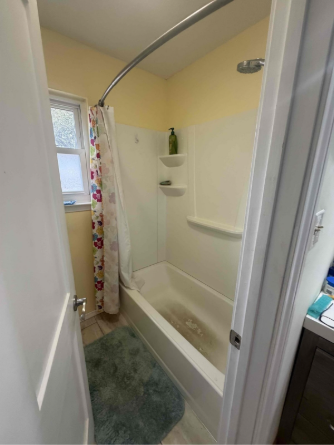
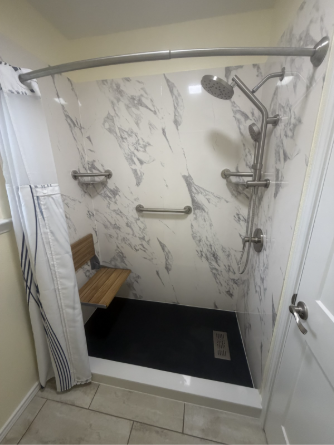
A real House Doctors of Austin tub-to-shower project. This is separate from the hypothetical bid comparison.
For one documented 35-square-foot bathroom, the original scope included tub and surround removal, an existing closet removal, drain adaptation for a new shower pan, shower wall work, grab-bar backing, ventilation and finish repairs. The completed photograph shows a shower seat, grab bars and a handheld shower.
Recorded contractor-work band: $10,000–$15,000, including a recorded change order. The homeowner’s shower valve, base and wall materials were listed as separate purchases, with tile selection also identified separately.
This band comes from the estimate and project tracking records. It is not a verified final paid invoice or the bathroom’s all-in cost, and it is not a current quote for similar work.
Now imagine comparing that contractor amount with a proposal that also supplies every fixture and finish. The lower number could look like a large saving even though the homeowner still needs to pay for products. The fair comparison adds those purchases and checks whether both contractors include the same work.
This is why we label the basis of a project number. A useful price tells you what it includes, what remains separate and which decisions could change it.
Allowances can hide a budget mismatch
An allowance is money included for something that has not been fully selected or priced. It helps make an early proposal possible, but it is only useful when it reflects the products and quantities you intend to buy.
For example, a $1,500 vanity allowance and a $4,000 vanity allowance create a $2,500 difference before other charges. That does not establish a quality difference by itself. One may cover only the cabinet; the other may include a countertop and sink.
Ask what each allowance covers, whether installation is elsewhere in the price, and how delivery, tax and contractor charges are handled. Confirm how both overruns and credits are calculated. Choosing major products early gives the comparison a firmer basis.
When a lower bid is good value
Lower overhead, efficient purchasing, a good match for the crew’s skills and a simpler scope can legitimately reduce price. Retaining the layout, choosing stock cabinetry and limiting custom fabrication can also save money without compromising the outcome you need.
Look more closely when an essential responsibility is missing or vague. “Tile included” leaves unanswered questions about demolition, preparation, waterproofing and coverage. “Plumbing included” needs a defined list of fixtures and connections. Owner-supplied materials can work well if compatibility, delivery, returns and damage responsibilities are understood.
The aim is to resolve uncertainty. You do not need to assume a lower bidder is cutting corners, and you should not assume a higher bidder has included everything.
Compare these items before choosing
Compare | Ask each contractor |
Layout and quantities | Which walls or fixtures move and how much tile, cabinetry or flooring is included? |
Products and allowances | Which models are specified and which selections remain open? |
Preparation and installation | What demolition, substrate repair, waterproofing and finish work are covered? |
Products supplied by the owner | What must I purchase and who checks fit, handles returns and manages delivery? |
Permits and trades | Who handles required permits, inspections and licensed specialty work? |
Coordination and completion | Who schedules the trades, protects the home, communicates and closes the punch list? |
Payment and changes | What are the milestones, exclusions, change-order terms and written warranty provisions? |
Send both contractors the same clarified scope and request revised proposals where needed. That gives you a more useful comparison than asking for a discount on two different projects.
Plan the total cost and the uncertainty separately
Your total budget starts with the proposal and adds excluded products and professional services you still need. Count each item once. Hold contingency separately so you can see the cost of the planned work and the reserve for unknowns.
For example, a hypothetical $35,000 contractor proposal plus $5,000 in owner purchases totals $40,000 before contingency. It should be compared with the same $40,000 scope in a fully supplied proposal, rather than only with the first contractor’s headline number.
For an existing-home remodel, a reserve of roughly 10%–15% of the defined construction scope is a reasonable starting point for discussion. Poorly documented conditions or major structural work may justify more. A reserve is available funding, not an automatic contractor charge or permission to spend it.
Concealed conditions need a written process
Moisture damage, deteriorated framing and previous work that needs correction can become visible after demolition. Ask what could reasonably be investigated beforehand and which conditions remain uncertain.
A written change order should identify the reason, added or removed work, price and schedule effect before approval and additional work, subject to any immediate action needed to protect people or property. Owner upgrades, allowance adjustments and concealed-condition repairs should be distinguishable from work already included.
Permit responsibility belongs in the comparison
Requirements depend on scope and jurisdiction. For example, Austin lists some finish work as exempt from building permits, but explicitly states that a new or replacement shower, tub or tub/shower combination is not exempt. A retained layout alone does not settle permit requirements. The City’s work-exempt guidance and contractor selection guidance are useful starting points.
For an addition or a larger renovation, the same comparison extends to drawings, engineering, foundations, roof connections, utilities and repairs to adjoining rooms. General contracting coordination has a real scope; identify which design and construction responsibilities are included in the agreement.
Where to save without creating rework
Ask for alternatives that keep the project functional: retain serviceable layouts, use standard cabinet sizes, simplify tile patterns and make selections before construction. Price each alternative so the saving is visible.
Phasing makes sense when the work can be separated cleanly. Remodeling a second bathroom later may be practical. Installing new finishes where a later wall or plumbing change will occur can create duplicate costs. Plan the sequence before buying materials.
Questions Austin homeowners ask about remodeling bids
Should I always get three bids
Several proposals can help, but comparability matters more than the count. Give contractors the same scope and selection information, then check relevant experience, references, insurance, required trade qualifications and communication alongside price.
Is a fixed price guaranteed never to change
Read the agreement. Allowances, exclusions, owner-requested changes and concealed conditions may affect the final amount. Clarify those terms before signing rather than relying on the words “fixed price” alone.
Can I ask a contractor to match a lower bid
Yes. First identify what changes would produce the lower price. A revised scope with clear savings is more useful than a price match that quietly removes work you expected.
Should I share my budget early
A planning range helps the contractor discuss feasible options. Pair it with your priorities and a written scope so you can judge the proposed value. If your budget and desired scope are far apart, simplifying or waiting may be the right choice.
Where House Doctors of Austin fits
We aim for fair pricing tied to a clear scope and coordinated remodeling work. Our service model includes background-checked and insured professionals, clear communication and a one-year labor guarantee on workmanship. If our estimate is higher than another, ask us to explain the inclusions and responsibilities behind the difference.
House Doctors of Austin focuses on bathroom, kitchen and interior remodeling. We also evaluate additions and select new-construction projects case by case, and continue to handle smaller repairs and improvements. We serve Austin, Cedar Park, Round Rock, Pflugerville, Georgetown and surrounding communities.
Bring your priorities, photos, rough measurements and comfortable investment range to the conversation. Request a remodeling estimate or call (737) 371-8827. For a broader budget, return to our Austin remodeling and home addition pricing guide.
Sources and example methodology
Prepared October 13, 2026. Bathroom planning bands follow our Austin pricing hub and companion bathroom guide, with context from the Austin 2025 Cost vs. Value Report and local published remodeling guidance. They are planning estimates rather than measured averages or House Doctors offers.
The $35,000 and $75,000 proposals and the allowance and budget calculations are hypothetical teaching examples. The photographed bathroom’s contractor band is supported by its estimate and project tracker, including a recorded change order; separately purchased products and the final paid total were not reconciled. Customer names and addresses are omitted. Permit statements are based on the linked City of Austin guidance and should be checked for the actual property and scope.