

Estimated Read Time: 10 minutes
Why Shipping Container Homes Are Gaining Interest in Central Florida
Shipping container homes have gained attention as homeowners search for creative ways to add living space. Online listings frequently advertise finished container dwellings at prices that appear dramatically lower than traditional construction, making them appealing for guest suites, backyard offices, studios, or accessory dwelling units (ADUs). As interest in shipping container homes in Central Florida continues to grow, many homeowners begin asking the same question: how do these structures truly compare to traditional construction in cost, comfort, and long-term livability?
However, the advertised purchase price usually reflects only the container structure itself, not the full cost of installing a comfortable and code-compliant residence. Foundations, utilities, insulation systems, HVAC installation, and permitting under the Florida Building Code all influence the final project cost.
In practice, we occasionally meet homeowners in Central Florida who began exploring container homes because the online purchase price looked attractive, only to discover during the planning stage that the installation, permitting, and climate design requirements are where most of the real project decisions occur.
In addition, Central Florida’s heat, humidity, intense sunlight, and seasonal storms create design challenges that steel structures must address differently than traditional homes.
Shipping container homes can absolutely work well when properly designed. The key is understanding the true cost, climate performance, and livability tradeoffs before making the decision.
Many homeowners first start exploring the idea while looking for space for a backyard office, guest suite, or perhaps that long-promised she-shed or man-cave.
Key Benefits of Shipping Container Homes
Shipping container homes offer several advantages that explain their growing popularity.
- Lower initial structure cost compared with some traditional small construction projects
- Modular construction, allowing containers to be combined into larger layouts
- Strong steel shell construction engineered for heavy cargo loads
- Fast structural installation once the site is prepared
- Structural shell that is resistant to rot and termites
- Compact footprint that can work well on smaller Central Florida lots
For certain applications in Central Florida, container homes can serve well as studios, guest suites, backyard offices, creative living spaces, or even a long-dreamed-about she-shed or man-cave.
Potential Drawbacks of Shipping Container Homes
Interior Width and Spatial Proportions
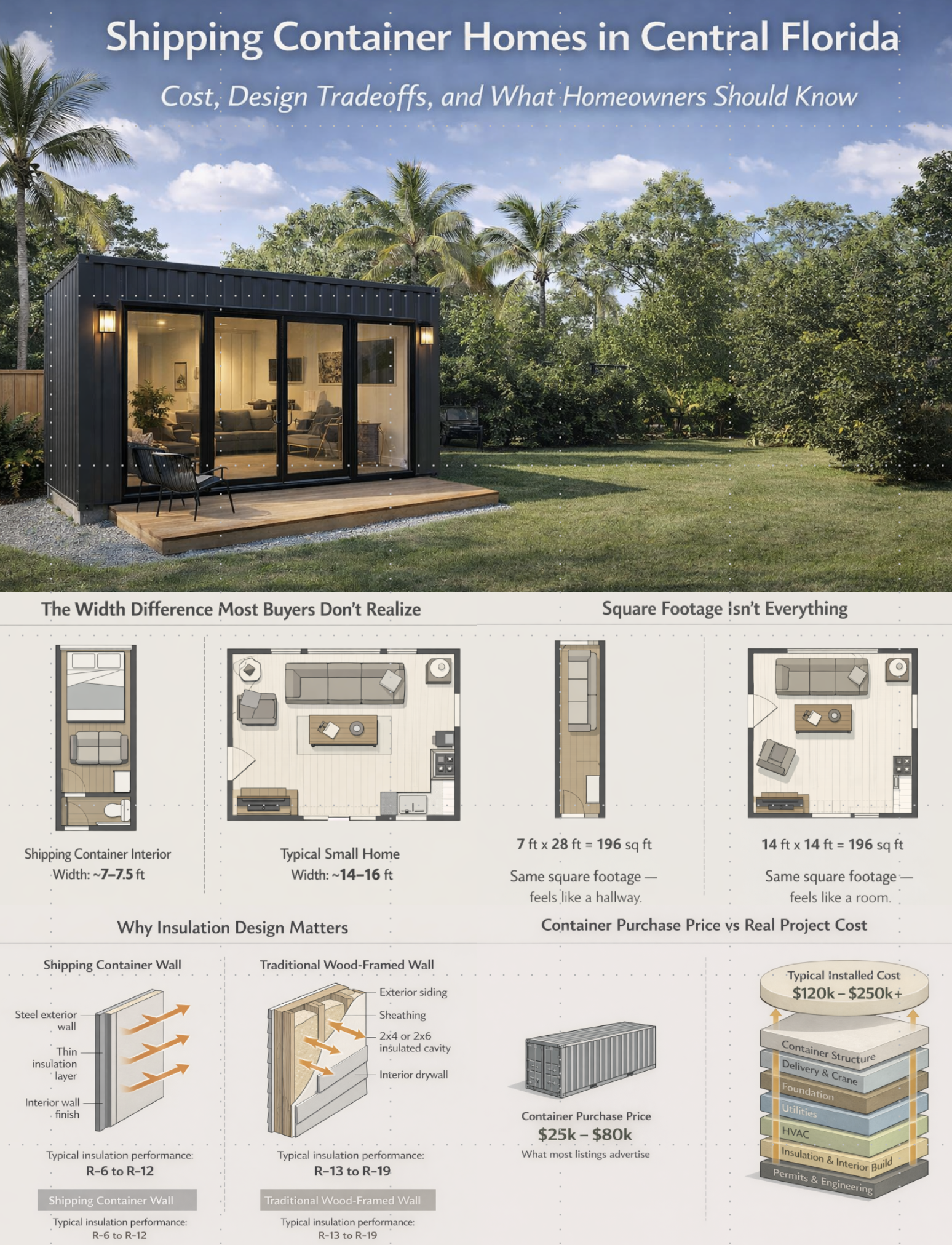
Shipping containers are approximately 8 feet wide on the exterior. After insulation, framing, wiring, and interior finishes are installed, the usable interior width typically becomes about 7 to 7½ feet.
To put this in perspective, that is roughly the width of a large walk-in closet or residential hallway.
Even a basic single-wide manufactured home is typically twice as wide as a shipping container, which dramatically changes how interior spaces feel and function in everyday living.
Architectural research consistently shows that room proportions strongly influence how people perceive space. Narrow rooms with lower ceilings tend to feel more confined than wider rooms with the same square footage.
This phenomenon is sometimes called the “hallway effect.” When a room is significantly longer than it is wide, the brain often interprets the space as a passageway rather than a place to spend time.
Furniture placement can also become challenging. Most residential furniture is designed for rooms 12–16 feet wide or more. In a seven-foot-wide space, homeowners often rely on built-in furniture, custom layouts, or apartment-scale furnishings to maintain comfortable walkways.
Thoughtful design can significantly improve how container interiors feel. Successful container home designs often use strategies such as:
- Large windows or sliding glass doors to extend sight-lines
- Open floor plans that reduce interior walls
- End-wall openings or glass walls that visually extend the space outdoors
- Combining multiple containers side-by-side to create wider rooms
- High-cube containers that provide additional ceiling height
The RV industry offers a helpful comparison. Recreational vehicles frequently use slide-out sections that expand the interior width when parked because designers recognize how strongly room width affects comfort—even for temporary living environments.
Photos online can sometimes make container interiors appear larger than they feel in person because real estate images often use wide-angle lenses that exaggerate room width.
With thoughtful design—particularly natural light, long sightlines, and wider layouts—container homes can feel significantly more spacious than their raw dimensions might suggest.
Ceiling Height
Most standard shipping containers measure about 8 feet 6 inches tall externally. After flooring systems, insulation, lighting, and ceiling finishes are installed, finished interior height typically becomes around 7½ feet or slightly less.
Designers often address this limitation by using:
- High-cube containers that add additional vertical space
- Exposed ceiling designs that avoid dropped ceilings
- Minimal ceiling finishes to preserve interior height
These design choices can noticeably improve how the space feels.
Insulation and Climate Performance in Central Florida
Another limitation of container construction involves available insulation depth.
Traditional homes typically use 2×4 or 2×6 wall framing, allowing insulation ratings around R-13 to R-19. These thicker wall cavities allow insulation materials to trap air pockets that slow heat transfer.
Shipping containers consist of thin corrugated steel walls with almost no insulation cavity. Builders must add interior framing to create insulation space, but the available depth is limited.
As a result, many container homes end up with effective insulation values closer to R-6 to R-12.
Steel construction also introduces thermal bridging, meaning heat travels through the metal structure more easily than through wood framing.
In Central Florida’s hot and humid climate, this often results in higher cooling demand and greater HVAC workload compared with similarly sized wood-framed structures.
However, once insulated and sealed properly, container homes can also become very airtight structures, which allows HVAC systems to control temperature and humidity more precisely when properly designed.
Design strategies that improve climate performance include:
- Tree shade or thoughtful site placement
- Secondary roof structures that reduce direct solar heat gain
- Continuous insulation systems that reduce thermal bridging
- Properly sized HVAC systems designed for Florida cooling loads
Even with good design, homeowners should expect more active climate management and somewhat higher cooling costs compared with traditional wood-framed construction.
Indoor Air Quality and Ventilation
Because shipping containers are built from continuous welded steel shells, container homes can become more airtight than many traditional houses once insulation and finishes are installed.
This affects buildings in two different ways.
From a thermal standpoint, steel walls transfer heat more easily than wood framing, which increases cooling demand in Central Florida’s climate.
From an air-quality standpoint, however, airtight construction allows air movement to be controlled intentionally rather than through random leaks in the building envelope.
Modern high-efficiency homes increasingly use this same approach.
Because of this, well-designed container homes often incorporate mechanical ventilation systems such as:
- Energy Recovery Ventilators (ERVs)
- Heat Recovery Ventilators (HRVs)
- Dedicated fresh-air intake systems connected to HVAC equipment
These systems introduce fresh outdoor air while exhausting stale indoor air, helping maintain healthy indoor air quality without sacrificing energy efficiency.
Without proper ventilation design, tightly sealed buildings—whether container homes or modern energy-efficient houses—can experience indoor air issues such as:
- humidity buildup
- elevated CO₂ levels
- accumulation of odors or volatile organic compounds (VOCs)
For this reason, HVAC systems for container homes should be designed not only for cooling capacity, but also for humidity control and fresh-air exchange.
Why Ventilation Design Matters More Than Many Homeowners Expect
In practice, many comfort and air-quality problems in compact structures—whether container homes, backyard studios, or accessory dwelling units—are not caused by the structure itself, but by HVAC systems that were designed only for temperature control and not for ventilation and humidity management. Proper system design considers cooling load, dehumidification capacity, and controlled fresh-air exchange, especially in Central Florida’s hot and humid climate.
Environmental and Material Considerations
Condensation and Moisture
Steel walls can develop condensation when warm indoor air meets cooler metal surfaces.
Proper container conversions manage this risk using:
- Closed-cell insulation systems
- Proper vapor barriers
- Ventilation strategies that control humidity
These measures are particularly important in Central Florida’s humid environment.
Spray Foam Insulation and Pest Activity
Many container homes use spray foam insulation to control heat transfer and condensation.
While effective, some foam materials can be tunneled by insects such as carpenter ants, which are common in Florida.
Using high-density foam products and maintaining pest control barriers around the structure helps reduce this risk.
Shipping Container Flooring Materials
Most shipping containers entering the United States include marine-grade plywood flooring treated with pesticides and preservatives used during international cargo transport. These treatments protect cargo from insects and comply with international phytosanitary regulations designed to prevent the spread of invasive species between countries.
However, these materials were developed for industrial shipping environments rather than residential living spaces, and some preservatives can off-gas over time.
Because containers were never designed as homes and treatment chemicals vary depending on the container’s age and manufacturer, reputable container home builders remove all original container flooring and replace it with new residential-grade subfloor systems during conversion.
Homeowners should verify that all original container wood materials have been removed before the structure is used as living space.
Rainfall Noise in Steel Structures
Steel structures transmit sound differently than traditional homes.
During Central Florida’s frequent heavy rainstorms, rainfall can be noticeably louder inside the structure.
Many container home designs address this by installing:
- Secondary roofing systems
- Insulated ceiling assemblies
- Acoustic insulation layers
These improvements reduce both heat gain and rainfall noise.
What Drives the Cost of Shipping Container Homes
The price advertised for container homes typically reflects only the converted container structure itself. The final installed cost in Central Florida includes many additional components.
Major cost drivers include:
- Foundation systems and structural supports
- Delivery logistics and crane placement
- Utility trenching for water, sewer, and electrical service
- Engineering and permits required by the Florida Building Code
- HVAC systems designed for Florida’s climate
- Removal of original container flooring materials
- Exterior finishes required to match the main home
- Structural reinforcement for doors, windows, and openings
Typical Installed Cost
At the time of publishing, completed container home projects in Central Florida often fall within these ranges:
Container structure purchase
$25,000 – $80,000
Delivery and crane placement
$3,000 – $10,000
Foundation and site preparation
$8,000 – $25,000+
Utility trenching and connections
$6,000 – $20,000+
Permitting and engineering
$3,000 – $12,000+
HVAC, plumbing, and electrical
$15,000 – $40,000+
Interior finishes and insulation
$20,000 – $60,000+
Completed container homes frequently fall between $120,000 and $250,000+ depending on layout and finishes.
Understanding the full installed cost rather than the container purchase price alone provides a much clearer picture of the true cost-to-value relationship.
Common Container Home Options & Choosing the Right System
Good: Single Container Conversion
- Lowest construction cost
- Fast installation
- Suitable for offices or small guest suites
Interior width remains narrow and insulation depth is limited.
Better: Multi-Container Layout
- Combines containers side-by-side
- Creates wider rooms and improved furniture placement
- Reduces the hallway effect
Requires structural reinforcement and engineering.
Best: Hybrid Container Construction
- Combines container modules with traditional wood framing
- Allows wider rooms and thicker insulation
- Improves climate performance in Central Florida
Hybrid designs often provide the best balance between creative architecture and long-term comfort.
Decision Guide for Central Florida Homeowners
Define the intended purpose of the structure.
Evaluate delivery access and site conditions.
Confirm insulation and HVAC design for Central Florida’s heat and humidity.
Verify the project will meet the Florida Building Code.
Consider interior proportions and furniture layout.
Compare the installed project cost with traditional small construction.
Long-Term Ownership & Maintenance
Container homes require thoughtful maintenance to perform well in Central Florida’s humid and storm-prone climate.
Owners should plan to:
- Maintain coatings that protect against rust and corrosion
- Monitor insulation systems for condensation or moisture issues
- Maintain HVAC systems designed for steel structures
- Manage pest control around insulation and skirting
Proper coatings and exterior finishes can significantly extend the lifespan of steel structures in Florida’s climate.
Container Home Buyer Safety Checklist
Before committing to a container home project in Central Florida, homeowners should confirm:
- All original container flooring and treated wood materials have been removed
- Insulation systems are designed for Florida heat and humidity
- Moisture control prevents condensation inside steel walls
- Structural modifications are engineered and permitted
- Roof shading or secondary roofing reduces solar heat gain
- HVAC systems are sized appropriately for steel construction cooling loads
Conclusion
Shipping container homes can serve as practical housing solutions in Central Florida, particularly for studios, offices, guest suites, or backyard retreats.
However, the decision should be based on a clear understanding of installed cost, climate performance, interior proportions, and building code requirements.
For homeowners considering a container home or any type of backyard living space in Central Florida, having a conversation with an experienced contractor early in the planning process can often clarify design choices, realistic costs, and permitting considerations before construction begins.
Even if the final project ends up being a container studio, backyard office, guest suite, or that long-promised she-shed or man-cave, understanding the design and cost implications early can prevent expensive surprises later.