

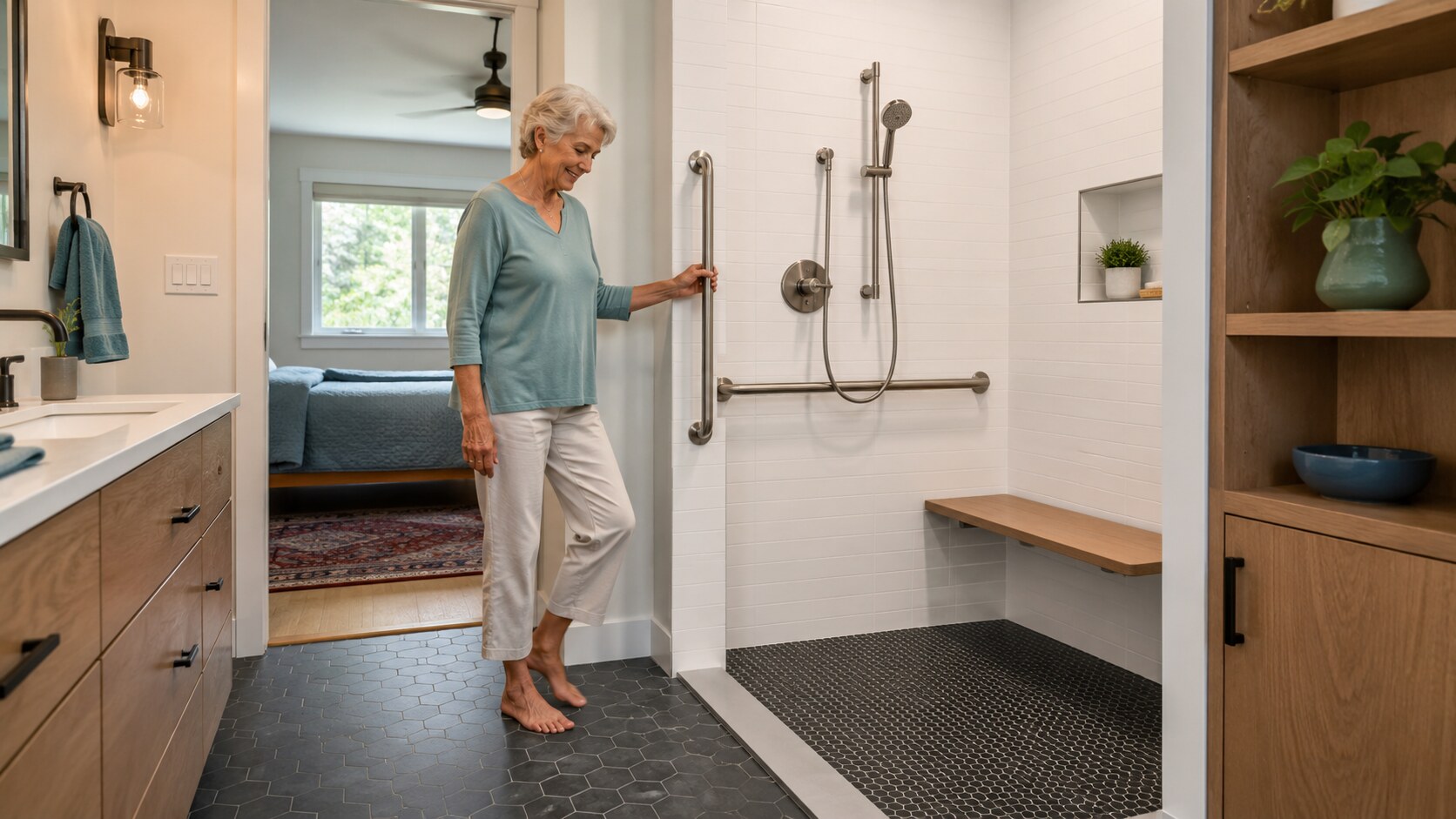
Ask a homeowner to name the riskiest room in the house and most will say the kitchen: knives, hot pans, gas burners. The data says otherwise. Falls are the leading cause of injury-related death for adults 65 and older, according to the CDC, and a large share of those falls happen at home — often in a small, wet, hard-surfaced room we all use several times a day.
The Wall Street Journal made this case in a July 2026 interview with Toronto architect and author Lloyd Alter, who has spent years arguing that the bathroom is the most hazardous room in the house — he calls it the "killer bathroom." His central point is worth repeating, because it reframes the whole problem: we tend to treat falls as an unavoidable part of getting older, when many of them are really the predictable result of bad design. Wet floors, slick curved surfaces, fixtures that force you to twist and step high, and almost nothing solid to hold onto.
Here in Central Texas, that design problem has a local accent. A lot of Austin's most desirable housing — the mid-century ranches in Allandale and Crestview, the bungalows in Travis Heights and Hyde Park, the older stock in Clarksville and Tarrytown — came with one compact bathroom built around a single tub-shower combo. Those bathrooms have aged, but the people using them have aged faster. Below are the changes that make the biggest difference, roughly in order of cost.
The tub-shower combo is the single biggest offender
Combining a tub's curved, slippery bottom with a shower's soap and water was never a good idea. Think about the mechanics of getting out: one foot is planted on a wet, rounded surface while the other swings high over a tub wall and lands on a bath mat or tile that may also be wet. For a moment, neither foot is stable, and there's frequently nothing to grab.
The best fix is a separate walk-in or barrier-free shower. If the footprint won't allow both a tub and a stall, converting the tub to a curbless or low-threshold shower is usually the safer trade — and in a small Austin bathroom, it often makes the room feel considerably larger. Where a tub is genuinely needed, a walk-in tub with a door and a seat solves the step-over problem.
Freestanding tubs photograph beautifully and age terribly
Sculptural freestanding tubs are everywhere in remodels right now. They're also among the hardest fixtures for an older adult to use: the rims are deliberately thin, so there's no wide edge to sit on and swing a leg over, the bottoms are often rounded, and because the tub sits away from the walls, there's nowhere to mount a grab bar.
If you're remodeling a primary bath you intend to stay in, that's a real consideration. A tub with a wide, flat deck edge set against a wall gives you a place to sit down and a place to anchor support hardware later.
Move the shower controls out of the water stream
This one costs nothing extra if you catch it at the design stage. When the valve sits directly under the showerhead, you have to reach through cold or scalding water to adjust it — and the sudden, awkward dodge people make to avoid the spray is itself a fall risk. Architectural researchers were flagging this as far back as the 1960s, which tells you how long we've been ignoring it. Put the controls near the entry, reachable from outside the spray, and add a thermostatic anti-scald valve while the wall is open.
Floors: matte over glossy, smaller tile over large
Slip resistance is a measurable property, but you don't need lab numbers to make good choices. Matte and textured finishes grip better than polished ones, and smaller tiles beat large-format slabs because all those grout lines add traction. Penny round, hex, and small mosaic tiles are popular in the shower floor for exactly this reason. If you're not ready to retile, a well-fitted non-slip mat with good suction and a bath rug with a rubber backing are meaningful improvements over what most bathrooms have now.
Grab bars: the cheapest safety upgrade in the house
Nothing else in a bathroom delivers this much protection for this little money. A properly installed grab bar — anchored into blocking or studs, not just drywall anchors — turns the most unstable moments of a shower into controlled ones. Every shower should have at least one; two is better, one for entry and one at standing height inside.
The commonly overlooked spot is the toilet. Getting on and off is a genuine fall risk, sometimes compounded by a brief drop in blood pressure when standing up quickly, and almost no one has anything to hold onto there. A vertical or angled bar beside the toilet is a small job with an outsized payoff.
And to address the objection we hear most: grab bars no longer have to look like hospital equipment. They come in matte black, brushed nickel, and bronze, and some double as towel bars or shower shelves. Nobody walking into the room needs to read them as medical hardware.
Toilet height is a real tradeoff, not a simple answer
The WSJ interview makes a provocative argument here: that standard toilets are already too high for our anatomy, and that today's taller "comfort height" models make matters worse. There's something to it physiologically. But it's genuinely a tradeoff, because a lower seat also means a longer, harder push to stand back up, which is why taller toilets are so widely recommended for people with knee, hip, or balance issues.
Our practical take: the right height depends on the person, their mobility, and their height — and whichever you choose, grab bars beside the toilet matter more than the seat height itself.
Don't forget the trip to the bathroom
Many bathroom falls start outside the bathroom, in a dark hallway at 2 a.m. Motion-activated night lights along the path, a switch you can reach before you enter rather than after, brighter and more even fixtures inside, and clearing the route of throw rugs and cords all belong in the same project.
Start with an assessment, not a shopping list
Every home and every body is different, which is why we don't hand out a generic checklist. House Doctors of Austin offers a free fall-prevention home assessment conducted by an Age Safe® America Aging-In-Place certified Senior Home Safety Specialist®. It takes 30 to 60 minutes, and you'll get specific recommendations for your home, with an explanation of why each one matters — so you can decide what to do now and what can wait.
From there, our background-checked technicians can handle the work itself: grab bar installation, barrier-free shower and walk-in tub conversions, raised or adjusted toilet heights, shower seats and benches, improved lighting, handrails, wider doorways, and no-step entries. All labor is backed by our one-year guarantee.
If you're already planning a bathroom remodel, this is the ideal moment to build safety in — adding blocking behind the walls for future grab bars costs almost nothing while the studs are exposed, and everything gets more expensive after the tile goes on.
Call House Doctors of Austin at (737) 371-8827 or reach us at housedoctors.com/austin-tx/contact-us to schedule your free assessment.
House Doctors of Austin is a locally owned and operated handyman, home repair, and home renovation service serving Austin, Cedar Park, Round Rock, Pflugerville, Georgetown, and the surrounding Central Texas area.